Module 5. Theories and Principles in the Use and Design of Technology
Module 5. Theories and Principles in the Use and Design of Technology
October 13, 2019

Blog by: Janeth B. Bacolod
LESSON 1:
Edgar Dale’s Cone of Experience
Experience is a direct observation of or participation in events as a basis of knowledge.

EDGAR DALE
“The cone is a visual analogy, and like all analogies, it does not bear an exact and detailed relationship to the complex elements it represents ”.
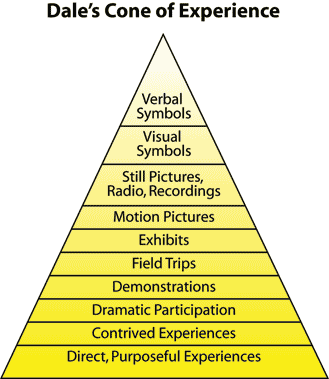
1. Direct Purposeful Experiences
-Are basically what the students can learn by doing it. This way of teaching is known to be the most effective way of teaching the students because experiences are the best teacher.

2. Contrived Experiences
-Are substitutes of real things when it is not feasible to bring the real thing to bring the real thing to the class. These include models, mock ups, specimens, objects, simulations and games.
3. Dramatized Experiences
an activities that allows students to actively participate in a reconstructed experience through role playing or dramatization.

4. Demonstrations
involves showing by reason or proof, explaining or making clear by use of examples or experiments. Put more simply, demonstration means 'to clearly show'.

5. Study Trips
- Educational trips that form a part of the school curriculum are very valuable as they provide the students the opportunity of learning through travel, especially to places that they may not otherwise get to visit.
- Apart from this, the trips also provide relief from the drudgery that academic study sometimes becomes, an opportunity for close interaction with peers that students enjoy so much, and a chance for the teacher to observe and interact with the student in a structure different from and more informal than the classroom.

6. Exhibit
- these are displays of models such as pictures, artifacts, posters among others that provide the information.

7. Television & Motion Pict
- Allow learners to experience the situation being communicated through the mediated tools.

8. Still Pictures, Recording, Radio
- The audio recorded materials or information broadcast through the radio.

9. Visual Symbol
- Are representations of direct reality, which comes in the form of signs and symbols.
- The following is a detailed discussion on the different kinds of visual symbols, which are drawings, sketches, cartoons, comics or strip drawing, diagrams, charts and graphs, maps, and posters.

10. Verbal Symbols
are only symbolic representations, but they still can be quite powerful and flexible.

References:
https://www.google.com/search?q=contrived+experiences+edgar+dale&rlz=1C1CHBF_enPH864PH864&sxsrf=ACYBGNQ_miKDBXx9a8NegpHvao9JFFzm-g:1570974360371&source=lnms&tbm=isch&sa=X&ved=0ahUKEwjey83Fr5nlAhUIvI8KHXpNBNcQ_AUIEigB&biw=1366&bih=657#imgdii=COr0gBmhod5FFM:&imgrc=0wN65Qpm8BFSkM:
https://educationaltechnologyforus.weebly.com/direct-purposeful-experiences.html#targetText=Direct%20Purposeful%20Experiences,as%20the%20foundation%20of%20learning.
https://educationaltechnologyforus.weebly.com/teaching-with-contrived-experiences.html#targetText=Contrived%20Experiences%20are%20substitutes%20of,%2C%20objects%2C%20simulations%20and%20games.
https://en.wikipedia.org/wiki/Demonstration_(teaching)
http://www.journal.kfionline.org/issue-7/the-role-of-study-trips-in-education
http://hcdc-eductech.blogspot.com/2011/09/visual-symbols.html#targetText=Visual%20symbols%20are%20representations%20of,graphs%2C%20maps%2C%20and%20posters.
Thank you for the information.
ReplyDelete